


Formal vs Informal English (With Examples)

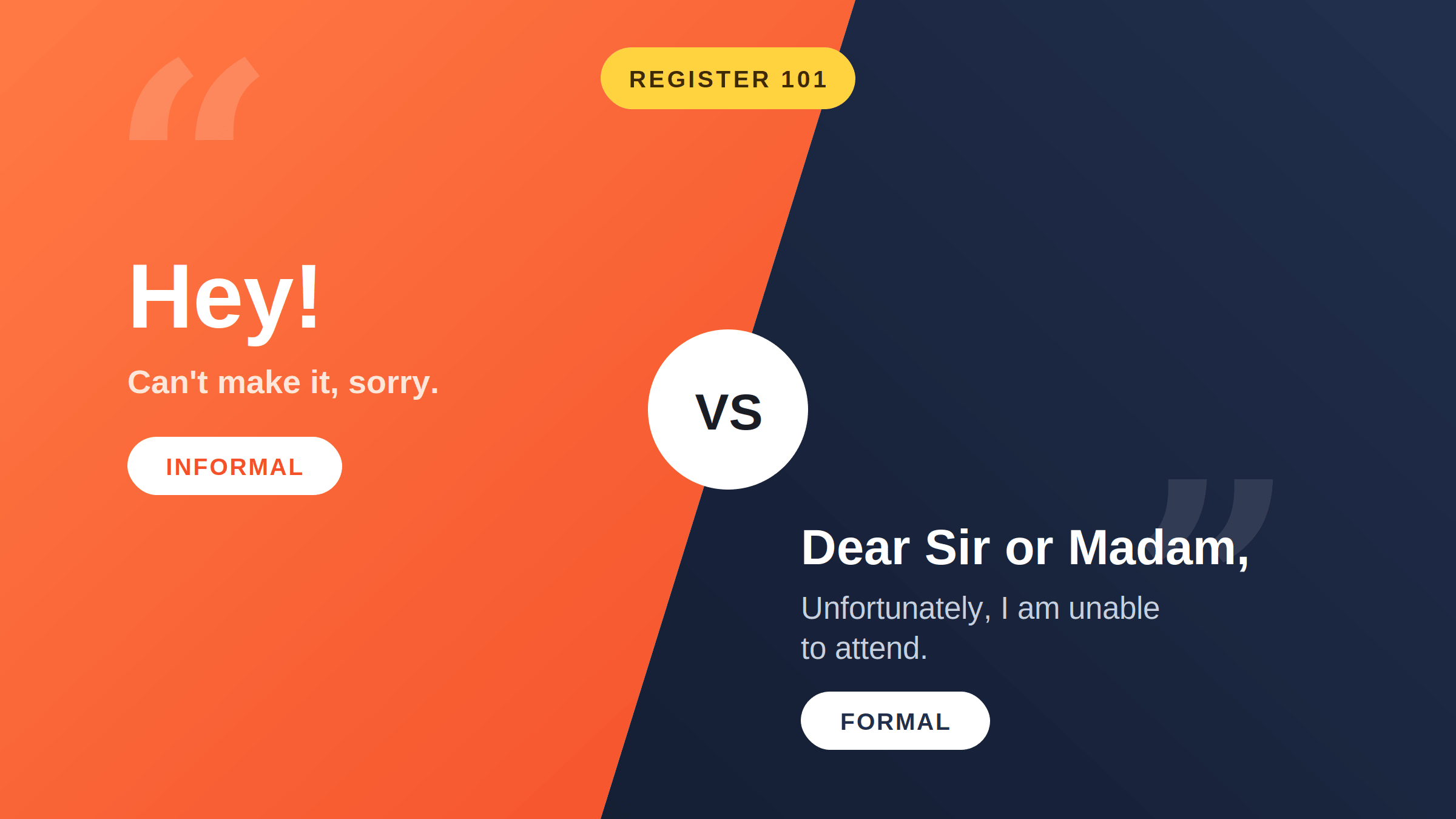
Ever sent an email and immediately wondered if you sounded too stiff? Or too casual? That moment of doubt is exactly where formal vs informal English lives — in the gap between what you wrote and how it lands.
Here's the myth that trips everyone up first: formal means correct, informal means sloppy. Neither is true. They're not a hierarchy, just two outfits for two different rooms — a tuxedo isn't "better" than jeans, it's just wrong for the wrong occasion. Informal English is what people actually use with each other constantly. Formal English is just the version that fits more distance.
Fifteen examples, side by side, make the pattern obvious fast.
Formal vs Informal English, Side by Side
| Situation | Informal Version | Formal Version |
|---|---|---|
| Asking for information | "Hey, can you send that over?" | "Could you please send the requested information at your earliest convenience?" |
| Declining an invitation | "Can't make it, sorry!" | "Unfortunately, I am unable to attend." |
| Starting a message | "Hey, quick question—" | "I am writing to ask about..." |
| Apologizing | "My bad, totally forgot." | "I apologize for the oversight." |
| Agreeing to something | "Yeah, sounds good." | "That works well for me, thank you." |
| Ending a message | "Talk soon!" | "I look forward to hearing from you." |
| Making a request | "Can you fix this by Friday?" | "Would it be possible to have this completed by Friday?" |
| Expressing disagreement | "I don't really think that works." | "I have some reservations about this approach." |
| Giving feedback | "This part's kind of confusing." | "This section could benefit from further clarification." |
| Introducing yourself | "Hey, I'm on the design team." | "My name is [Name], and I work with the design team." |
| Turning down a request | "Can't really help with that right now." | "Unfortunately, I am unable to assist at this time." |
| Asking for clarification | "Wait, what do you mean?" | "Could you clarify what you meant by that?" |
| Following up | "Just checking if you saw this?" | "I wanted to follow up on my previous message." |
| Closing a phone call | "Alright, talk later!" | "Thank you for your time. Goodbye." |
| Asking someone to wait | "Hang tight a sec." | "Please allow a moment." |
For the casual, spoken-style patterns specifically — gonna, wanna, kinda — the Owlift guide covers colloquialisms examples with 45+ real-world instances if you want to go deeper.
The Signals, Grouped
You don't need a rulebook. You need four categories.
Word choice
- Contractions — "I'm," "can't" (informal) vs. "I am," "cannot" (formal). One word choice, whole tone shift.
- Word origin — shorter, everyday words vs. longer, more precise ones ("buy" vs. "purchase"). You can usually feel this one before you can explain it.
- Slang and filler — "gonna," "kinda," "lol" belong almost entirely to informal, spoken-style writing.
Sentence structure
- Length — informal chops into short bursts, formal stretches into full clauses connecting two or three ideas.
- Modal verbs — "could you possibly" softens into formal, "can you" stays direct. Neither is rude, just different distances.
Punctuation and tone
- Emphasis — exclamation points and emoji read informal, restrained punctuation reads formal and lets word choice carry the weight instead.
- Hedging — "I think, perhaps" (formal) vs. "not sure but maybe" (informal), same idea dressed differently.
Greetings and closings
- Opening line — "Hey" vs. "Dear." Often the very first word that gives away the register.
- Sign-off — "Thanks!" vs. "Sincerely." Worth matching the opening — a formal greeting with a casual sign-off usually feels slightly off.
Stack two or three of these in the same message, and the register basically announces itself. None of them work alone — it's always the combination that gives it away, not any single word choice by itself.
A few more pairs, just to round it out past fifteen:
| Situation | Informal | Formal |
|---|---|---|
| Requesting a document | "Send that file when you can?" | "Please forward the document at your earliest convenience." |
| Confirming plans | "We're still on for Tuesday, right?" | "I am writing to confirm our meeting on Tuesday." |
| Expressing thanks | "Thanks a ton for this!" | "I sincerely appreciate your assistance with this matter." |
| Raising a concern | "This seems off to me." | "I would like to raise a concern regarding this." |
| Wrapping up a project | "That's a wrap!" | "This concludes the project." |
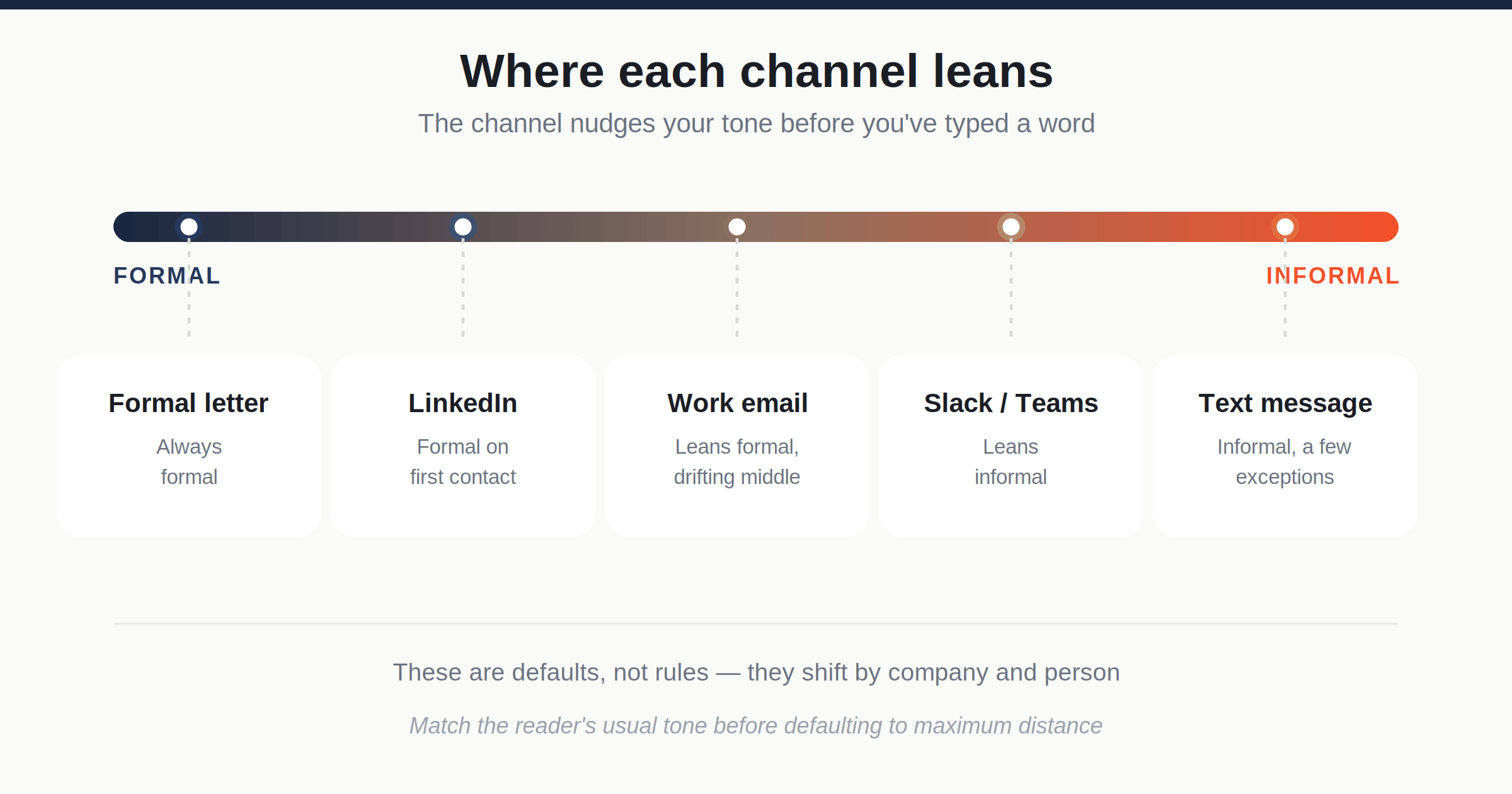
The channel you're writing on nudges you one way before you've typed a word.
| Channel | Usual Default |
|---|---|
| Formal letter | Formal |
| Work email | Leans formal, drifting middle |
| Slack / Teams | Leans informal |
| LinkedIn message | Formal, especially first contact |
| Text message | Informal, with exceptions (landlords, doctors) |
| Phone call | Informal, unless it's a formal interview |
Worth noting: these defaults shift over time. Email used to default formal, like a printed letter would. Most workplace email now lands somewhere in the middle, and tools like Slack or Teams push everyday communication further toward informal, contractions and all. The categories haven't disappeared — they've just moved, and they keep moving by company, industry, and the specific person you're writing to.
The Three-Step Conversion
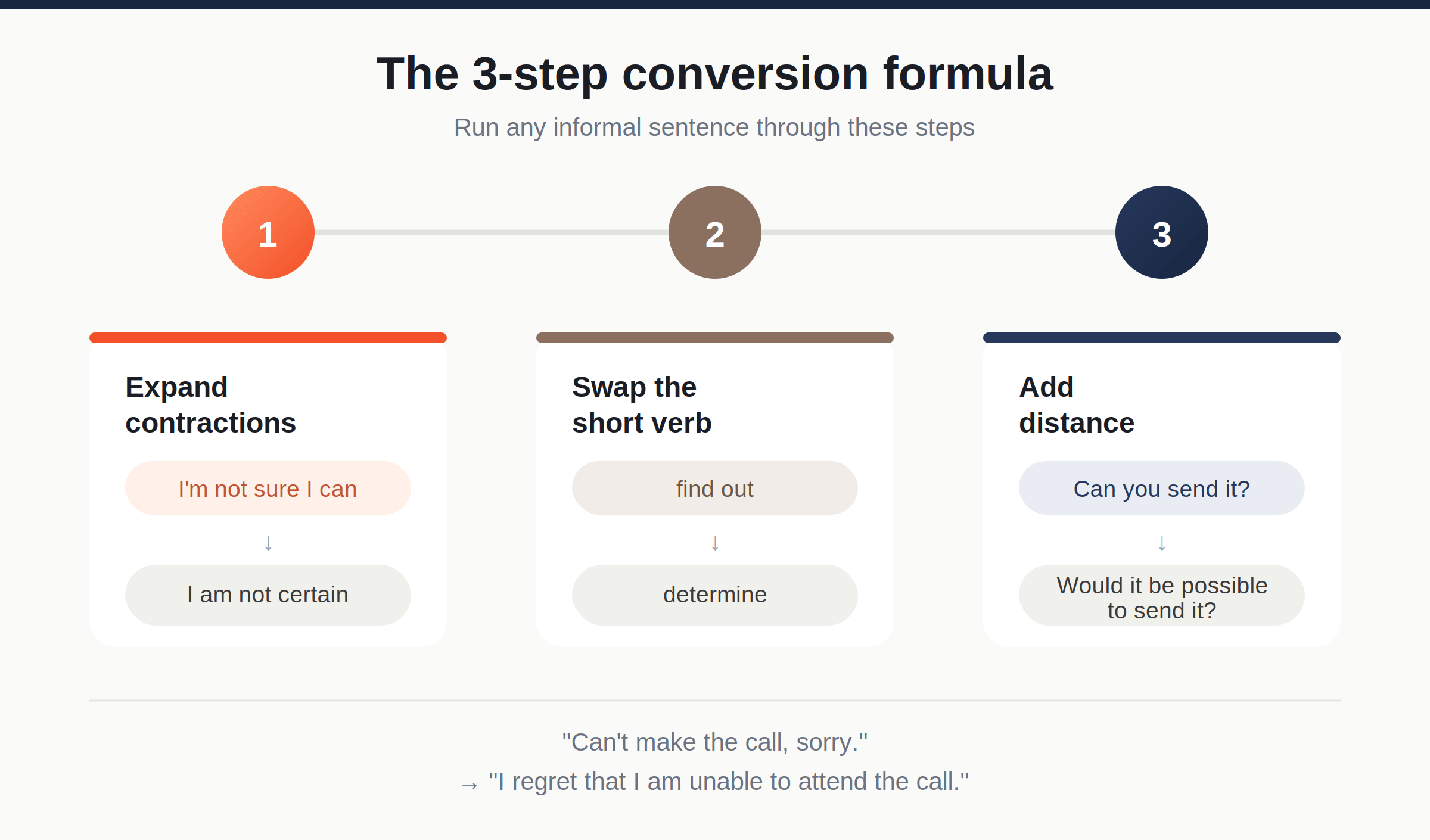
When you need to shift a sentence from informal to formal, run it through three steps instead of rewriting from scratch.
- Expand the contractions. "I'm not sure I can" becomes "I am not certain I am able to."
- Swap the short verb for its longer cousin. "Find out" becomes "determine." "Put off" becomes "postpone."
- Add distance to the request. "Can you send it?" becomes "Would it be possible for you to send it?"
Full example: informal — "Hey, I'm not sure I can get this done by Friday, is that okay?" Formal — "I am writing to let you know that I am not certain I will be able to complete this by Friday. Would it be possible to discuss an alternative timeline?" Same request. Different room.
Second example, shorter: informal — "Can't make the call, sorry." Formal — "I regret that I am unable to attend the call." Three steps, applied fast: contraction expanded, apology reworded without slang, distance added through "regret" instead of "sorry."
What Actually Made This Real
A few years back, my boss asked a quick question on Slack. I typed back fast: "yeah for sure, no worries lol." In the window right next to it, I'd just typed almost the exact same sentence to my old roommate, Priya, back when we shared an apartment in Austin — one about weekend plans, not deadlines. Two nearly identical messages, one to my boss, one to a close friend, sitting there side by side. Nothing bad happened. But that's the moment formal versus informal stopped being abstract for me.
Formal and informal English are a bit like the same song, recorded two different ways — one mixed for a packed concert hall, one close-mic'd for a single listener with headphones on. Same melody, completely different room.
By the way, my mom still thinks "lol" means "lots of love." I've stopped correcting her. And honestly, I still don't have a clean rule for international teams — some cultures find "hey" too familiar, others find "Dear Sir" too cold. That part just comes with practice.
What the Grammar Books Say
British Council's own notes on register put it simply: whether English lands as formal or informal depends on who's reading or listening, why you're writing, and the situation — not a fixed rule about which words are "allowed." That's really the whole idea, confirmed by people who teach this for a living.
Purdue OWL frames it the same way: the right level of formality is set by your audience and your purpose, not by some universal standard of "correct" English. The same sentence can be perfectly appropriate in one setting and out of place in another, depending entirely on who's reading it and why.
A Few Mistakes Worth Avoiding
Mixing registers within one message is the most common slip — opening with "Dear Sir or Madam" and closing with "Talk soon!" reads as inconsistent, not friendly. Over-formalizing out of nervousness is another: piling "kindly," "please," and "at your earliest convenience" into one short request doesn't add politeness, it just adds friction. Assuming formal is always the safer choice can backfire with people you already know well — matching their existing tone usually works better than defaulting to maximum distance. And copying a formal template without adjusting it can carry a tone that doesn't actually match your relationship with the reader, which is worth a quick reread before sending.
Quick Reference: Formal vs Informal at a Glance
| Feature | Informal English | Formal English |
|---|---|---|
| Contractions | Common ("I'm," "don't") | Avoided ("I am," "do not") |
| Vocabulary | Shorter, everyday words | Longer, more precise words |
| Sentence length | Short, sometimes fragmented | Longer, fully structured |
| Tone | Personal, direct | Distant, measured |
| Punctuation | Exclamation points, emoji | Restrained, minimal emphasis |
| Typical use | Friends, family, texts, casual chat | Work emails, official letters, interviews |
| Best default with strangers | Risky until you know them | Safer starting point |
| Modal verbs | Direct ("can you") | Softened ("could you possibly") |
| Word origin | Shorter, Anglo-Saxon roots | Longer, Latin/French roots |
Before You Hit Send
- Does the tone match the person? Match how formal or casual this specific reader usually writes to you, not a general rule.
- Would it sound rude without the cushioning? Remove every "sorry" and "just" — if it still sounds fine, cut them.
- Check the contractions. Spell them out for formal, keep them for informal — consistency matters more than the choice itself.
- Say it out loud. Would you say this exact sentence to their face? If not, it's probably drifting too casual.
- Think about the paper trail. Gets filed, forwarded, or reread later? Lean formal by default.
A Few Situations Worth a Second Look
- A first message to a stranger — lean formal, then match their reply. It's easier to loosen up later than walk back something too casual.
- Group chats with your manager present — match the most formal person in the thread, not the group average.
- Written follow-ups after a relaxed conversation — the written version gets reread, sometimes forwarded, so it pulls toward formal even if the talk wasn't.
- LinkedIn messages to people you don't know — treat it like a formal introduction, regardless of how casual the platform feels. The reader doesn't know you yet.
- Customer support chats — deliberately in the middle, on purpose, not by accident. Friendly enough to feel human, structured enough to feel professional.
- Emailing a professor — leans formal, and the title question (Professor or Dr) genuinely differs by country.
Final Thoughts
I don't think about formal versus informal as a rulebook anymore. It's a mirror — however close I am to someone, my language shifts to match it, without much conscious thought at this point. I still get it wrong occasionally, but I notice almost immediately now instead of finding out by accident.
That's the whole shift behind formal vs informal English: knowing which recording, concert hall or quiet studio, the person on the other end is actually listening to.


