


Colloquialisms in Academic Writing: What to Cut


Here's something that took me a while to notice. Universities hand students two pieces of advice about academic language, and on the surface they contradict each other.
The first: cut the vague words. Sort of, a bit, these days, big, pretty much. Be precise.
The second: hedge your claims. The data suggest. This may indicate. Participants tended to. Don't overstate.
Those are the same words. Tends to is exactly the kind of soft, imprecise phrasing the first list tells you to delete, and exactly what the second list requires. Nobody explains where the line falls, and I think that gap is where most of the confusion about academic tone actually lives.
The word list is the easy part, so let's get it out of the way.
What the lists say
They agree with each other almost completely, which is a decent sign they're right.
| Cut | Use |
|---|---|
| can't, won't, it's | cannot, will not, it is |
| thing, stuff | material, factor, element |
| lots of | many |
| sort of, a bit | somewhat, slightly |
| these days | nowadays, currently |
| big, huge, nice | name the actual quality |
| Also / But / So (sentence-initial) | Additionally, However, Therefore |
| basically, actually, literally | (delete) |
| a drop in the ocean, cut to the chase | (delete) |
Capstone Editing, quoting the usage scholar Pam Peters (2007), puts the reason well: colloquialisms "undermine the serious effect you want to have on the reader." Peters is right, and this table takes about ten minutes to apply to a finished draft.
It's also the least important thing on your list. Fixing contractions won't make a weak argument strong. Getting your hedging wrong can make a strong argument indefensible.
The advice that contradicts it
The University of Hertfordshire's academic English resource, UEfAP, describes cautious language as a core feature of academic writing and calls it, in its own words, "hedging" or "vague language." That's the same label the taboo lists use as an accusation.
So what's going on?
The difference is what the words are doing. Vagueness hides how strong a claim is — the reader can't tell whether you measured something or guessed. Hedging announces it. "Children living in poverty do poorly in school" states a universal. "Children living in poverty tend to do poorly in school" states a tendency, which is what the evidence actually supports.
Same softening word. Opposite function. One conceals the strength of your claim; the other reports it accurately.
That reframing is the whole thing, and it's why I'd stop thinking of hedges as weak language. A hedge is a measurement. It says: here is how much weight this sentence can carry.
Where hedging belongs, and where it doesn't
Not everywhere, which is the part that gets lost.
Methods and Results — minimal. You describe what you did and what happened. "The sample included 240 participants" needs no softening. Hedging here reads as uncertainty about your own procedure.
Introduction and Literature Review — moderate. You're characterizing other people's findings, and some of those are contested.
Discussion and Conclusion — heaviest. This is where you move from what you found to what it means, and every step past the raw data is interpretation. Corpus studies of hedging in research articles concentrate on discussion sections for exactly this reason: that's where the hedges are.
A useful test: if you're reporting, don't hedge. If you're interpreting, hedge.
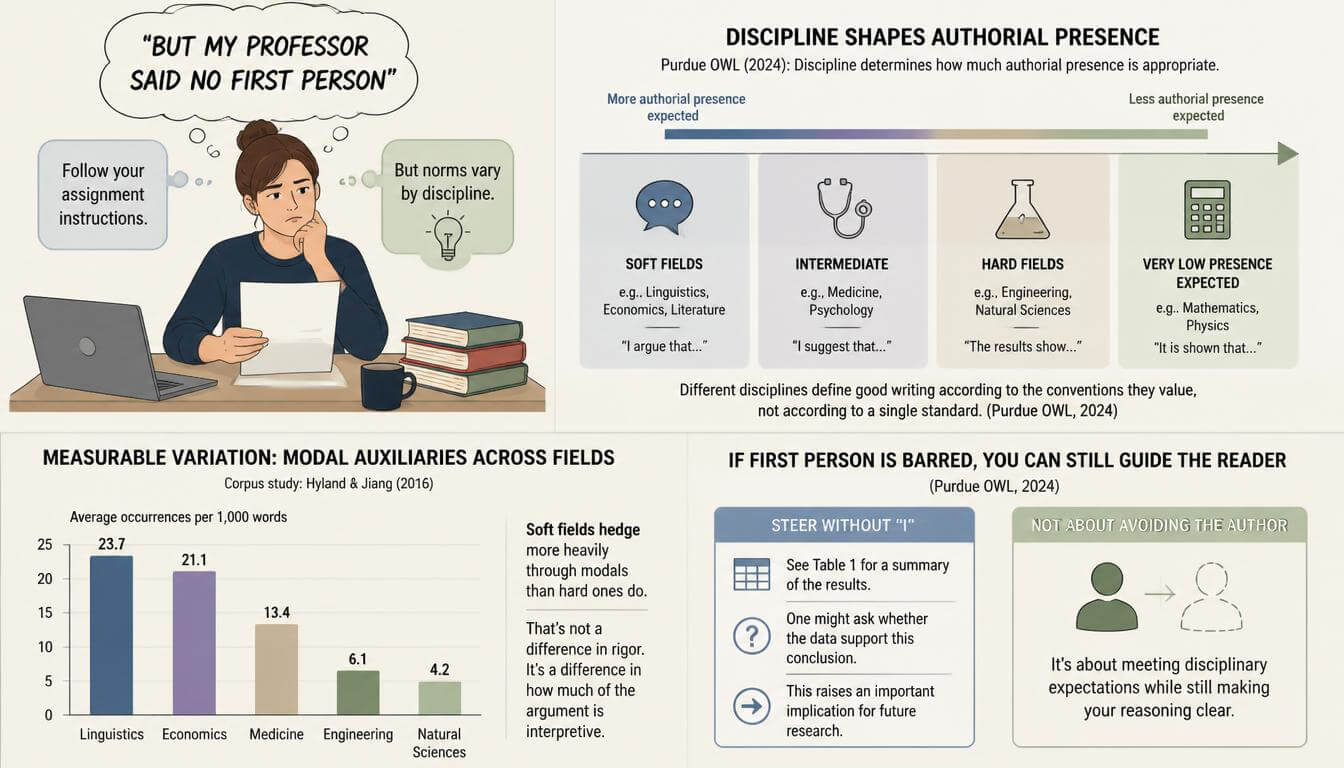
"But my professor said no first person"
Fair — and they may have meant it. Follow the instruction you were given. But it isn't a universal rule, and knowing that changes how you read other people's papers.
Purdue Global's writing center (2024) puts it plainly: the discipline you're writing for determines how much authorial presence your writing should have. Some fields expect I argue. Others treat it as an intrusion. Purdue OWL makes the broader version of this point too — different disciplines define good writing according to the conventions they value, not according to a single standard.
There's measurable variation underneath this. One corpus study of modal auxiliaries across fields found them most frequent in linguistics and economics, least frequent in engineering and the natural sciences, with medicine in between. Soft fields hedge more heavily through modals than hard ones do. That's not a difference in rigor. It's a difference in how much of the argument is interpretive.
And if first person is genuinely barred in your assignment, Purdue Global's guidance offers a workaround: you can still steer the reader with "See Table 1" or "One might ask whether..." without a pronoun in sight.
If English isn't your first language
This is the part I'd actually spend time on, and it's the part the word lists never mention.
Hedging conventions don't transfer between languages. How much caution a claim needs, how directly you're allowed to disagree with a published author, whether confidence reads as competence or arrogance — these are settled differently in different academic cultures, and nobody tells you when you switch.
Ken Hyland, who has spent a career on this, has documented it directly. His 1997 study with John Milton compared qualification and certainty in first-language and second-language student writing and found systematic differences. Elsewhere he describes second-language writers running into pragmatic failure in English academic settings — not from weak grammar, but from mismatched expectations about indirectness and formality.
The comparative work keeps confirming it. Yang's 2013 study in the Journal of Pragmatics examined hedging across English and Chinese scientific discourse and found linguistic and cultural variation. Similar comparisons exist for Turkish, Persian, and Japanese writers against English-language norms.
Here's the detail that bothered me most when I found it. Hyland (1994) has also pointed out that ESL textbooks contain very little material on hedging — and that because of the gap, both teachers and learners tend to treat it as unimportant. So the thing most likely to make an international student's paper read wrong is the thing least likely to appear in their coursebook.
What that means practically: you can't calibrate this from a blog post, including this one. I don't know which direction your first language pushes you — some rhetorical traditions run more assertive than English academic prose, some far more deferential, and the research hasn't produced a clean lookup table by language.
What works instead is reading. Pull three recent papers from the journal or department you're writing for. Mark every may, suggests, appears, tends to, it is possible that. Count them. That's the local norm, and it's more reliable than any general rule about formality — including the one about contractions.
One thing none of this touches: material you're quoting. Scribbr notes it and no one else does, but when you reproduce an interview or quote a source, the informality stays. Cleaning it up is a misquotation.
Where the lists go too far
There's a failure mode on the other side, and I see it more often than sloppiness.
One guide I came across suggests turning "kids these days are glued to their phones" into "adolescents demonstrate high engagement with mobile devices." The first sentence is too casual for a paper. The replacement is worse — it's longer, it's vaguer about the actual behavior, and it substitutes bureaucratic register for meaning. "Adolescents use mobile devices heavily" would have done the job in five words.
Formality is not the same as inflation. If you want the general version of that distinction, the formal vs informal English piece covers how register works outside academic contexts, and the colloquialisms examples list has the everyday phrases themselves.
Take one paragraph from your discussion section and underline every claim in it. For each one, ask what the evidence actually supports — measured, inferred, or speculated — and check whether the sentence says so. That's the calibration everything else is downstream of, and it takes about five minutes on a single paragraph.
References & Sources
- Hyland, K. & Milton, J. (1997). Qualification and certainty in L1 and L2 students' writing. Journal of Second Language Writing, 6(2), 183–205
- Hyland, K. (1994). Hedging in academic writing and EAP textbooks. English for Specific Purposes, 13(3), 239–256
- Yang, Y. (2013). Exploring linguistic and cultural variations in the use of hedges in English and Chinese scientific discourse. Journal of Pragmatics, 50(1), 23–36
- Hardjanto, T. D. (2016). Hedging through the use of modal auxiliaries in English academic discourse. Humaniora, 28(1), 37–50
- Purdue OWL — Writing is Discipline Specific
- Purdue Global Academic Success Center — Incorporating a Writer's Voice in Academic Writing (2024)
- UEfAP — Writing Features: Hedging
- University of Wisconsin, ESL 117 — Controlling Tone Through Hedging
- Scribbr — Words and Phrases to Avoid in Academic Writing
- Capstone Editing — Avoiding Colloquial Language in Academic Writing
- Writefull Academic Writing Lab — Avoiding informal language


