


15 Common Grammatical Errors Native Speakers Make

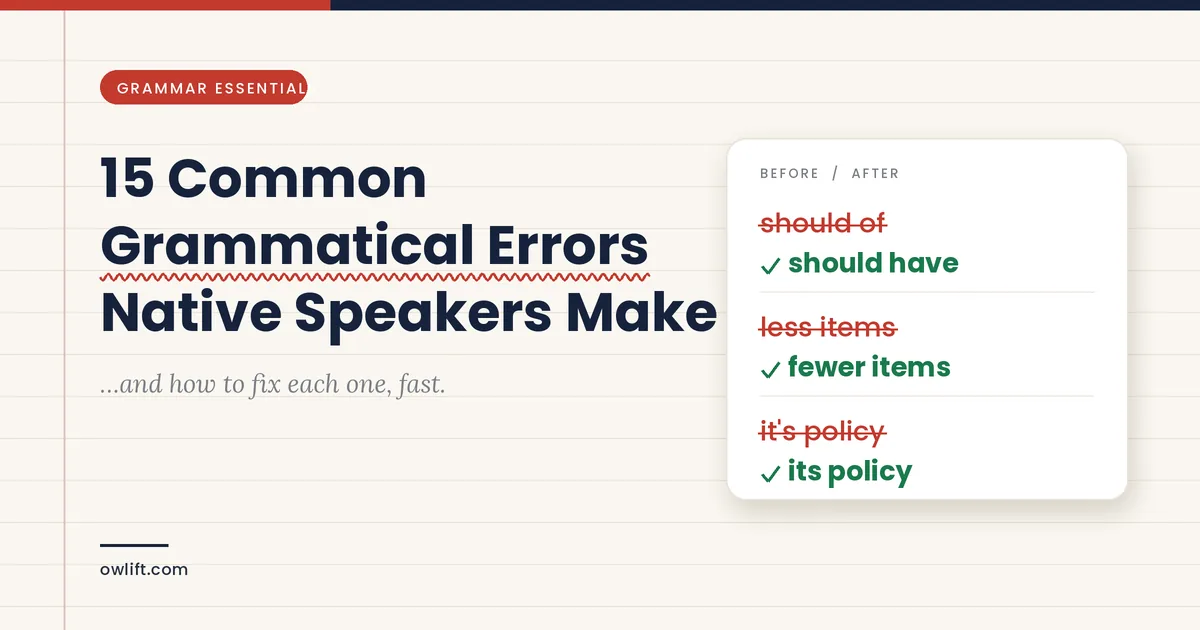
You fire off a carefully worded email to a client. You're making a case for a budget increase, a project extension, or maybe just a meeting. You read it twice. It sounds smart, persuasive. Then, five minutes after you hit send, you spot it. "Should of." Not "should have." Should of.
Here's the uncomfortable truth: spellcheck doesn't catch the worst mistakes native speakers make. It can't. The words are real. They're spelled correctly. They're just... wrong. And they sit there in your email, quietly eroding your credibility like a coffee stain on a crisp white shirt.
We all have grammar blind spots. Not because we're careless, but because spoken English is a slippery, regional, constantly shapeshifting thing. The rules that govern a formal report on one side of the Atlantic dissolve into a casual chat on the other. This isn't about being the grammar police. It's about knowing where the traps are so you can step over them when it counts.
Here's your cheat sheet first—a quick-reference table covering all 15 errors. Scan it. Bookmark it. Then dive into the details below.
Quick Reference: 15 Grammar Errors at a Glance
| # | Error | Correct Form | The Shortcut |
|---|---|---|---|
| 1 | Me and John went... / Send it to John and I | John and I went... / Send it to John and me | Drop the other name. Does it still work? |
| 2 | I could care less | I couldn't care less | If you care zero, you can't go lower. |
| 3 | Should of / would of / could of | Should have / would have / could have | Write it out fully. "Of" is a preposition. |
| 4 | Lay down on the bed | Lie down on the bed | You lay something down. You lie down. |
| 5 | Each student must bring his book | Each student must bring their book | Singular "they" is 600 years old. Use it. |
| 6 | Less items / less people | Fewer items / fewer people | Can you count it? Use "fewer." |
| 7 | The report that I wrote, which is on the desk... | The report, which I wrote, is on the desk. | Can you cut the clause? Use "which" + commas. |
| 8 | I feel nauseous | I feel sick / I feel nauseated | "Nauseous" = causes nausea in others. |
| 9 | The weather effected my plans | The weather affected my plans | Verb = affect. Noun = effect. (95% of the time.) |
| 10 | After rotting for weeks, my brother brought the potatoes | After rotting for weeks, the potatoes were brought up | Put the modifier next to what it modifies. |
| 11 | Better then ever | Better than ever | Comparison = "than." Time/sequence = "then." |
| 12 | Farther discussion | Further discussion | Physical distance = farther. Figurative = further. |
| 13 | Whom called? | Who called? | He → who. Him → whom. |
| 14 | Different than (global formal) | Different from | "From" is standard in all varieties of English. |
| 15 | The company and it's policy | The company and its policy | Expand "it's" to "it is." If it fails, use "its." |
1. "Me and John" vs. "John and I"
This is the crown jewel of native-speaker errors, and it's almost entirely a problem of hypercorrection. We were scolded as kids—"It's 'John and I,' not 'me and John'!"—and the lesson stuck a little too well.
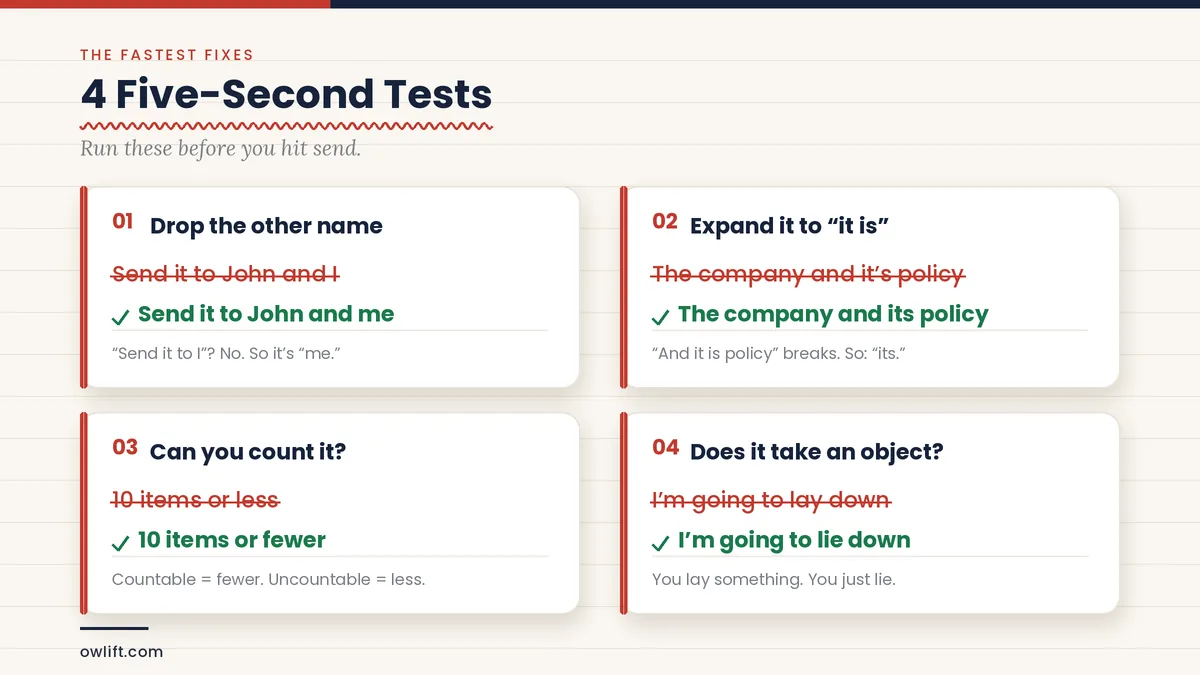
The result? We now say "John and I" everywhere, including places where "me" is actually correct. The trick is brutally simple: remove the other person. "Please send the report to John and I" becomes "Please send the report to I." Your ear screams. That's because the preposition to needs the object pronoun me.
Fix: Drop the other name. Let your ear decide. Use "I" as a subject (doing the action), "me" as an object (receiving the action).
2. "I Could Care Less"
This one is a beautiful linguistic puzzle. When someone says "I could care less," they almost always mean the exact opposite: they couldn't care less. The amount of care they possess has hit absolute zero.
So why do millions of native speakers say it wrong? Idiomatic drift. The phrase has become an entrenched, sarcasm-tinged fixed expression in American English. In casual conversation, correcting it feels pedantic. But in writing? "I couldn't care less" is logical, precise, and impossible to argue with.
Fix: Save the ironic version for people who know you're joking. In any professional or written context, default to "I couldn't care less."
3. "Should Of" (and "Would Of," "Could Of")
This error is 100% the fault of our ears. The contraction "should've" sounds indistinguishable from "should of." Our brains, transcribing sound to text, reach for the preposition.
But "of" is a preposition. It doesn't belong after a modal verb. What you mean is "should have."
Fix: When proofreading, search your document for " of" after "should," "would," or "could." Replace with "have." Or write it out fully every time. Your career will thank you.
4. Lay vs. Lie
If you master this, you join a very small club. Here's the core mechanic: "Lay" needs something to act on. "Lie" doesn't.
You lay something down. You lay the book on the table. Yesterday, you laid the book on the table. The hen lays an egg.
You lie down. You lie on the sofa. Yesterday, you lay on the sofa. No object needed.
The real chaos agent is the past tense of "lie," which is "lay." Yesterday I lay down. It's grammatically perfect and looks completely wrong to most native speakers.
Fix: Memorize the object rule. In casual speech, almost no one will blink if you mess this up. In formal writing, getting it right signals precision.
5. The Singular "They" (And Why It's Fine)
Older style guides spent decades insisting that "he" was the default pronoun for a person of unspecified gender. Usage has moved on, decisively. "Someone left their umbrella" is now standard, natural English. It has been for centuries—Chaucer, Shakespeare, and Austen all used it.
The problem arises with subject-verb agreement. "They" is grammatically plural, so we say "they are." This creates a subtle friction: "Someone is at the door, and they are waiting." Is that wrong? No. The alternative—"he or she is waiting"—is clunky.
Fix: In modern professional writing, default to "they." It's clear, inclusive, and here to stay. This is one of the rare cases where a genuine linguistic debate exists—traditionalist vs. modern usage—and knowing both sides signals expertise. But the practical recommendation is settled.
6. Less vs. Fewer
The rule: "fewer" for things you can count; "less" for things you can't.
- Fewer complaints, fewer employees, fewer dollars.
- Less stress, less money, less time.
The trap: "10 items or less" on the supermarket checkout sign. We've seen it so often it feels correct. It isn't.
Fix: Ask yourself: "Can I stick a number on this?" If yes, reach for "fewer." If you can count the items (and you can, it's ten), "fewer" is correct.
7. Which vs. That
Getting this right adds an immediate professional sheen to your writing.
Use "that" when the clause is essential to identifying what you're talking about. Take it out and the sentence stops making sense. "The report that I wrote yesterday is missing." (Not any report—that specific one.)
Use "which" for bonus information, set off by commas. "The report, which I wrote yesterday, is missing." (There's only one report; I'm casually adding that I wrote it yesterday.)
Fix: If you can cut the clause and keep the core meaning, it's a "which" clause. If cutting it changes what you're pointing at, it's "that."
8. Nauseous vs. Nauseated
Traditionalists hold the line here: "nauseous" means causing nausea, not feeling it. A pile of rotting garbage is nauseous. You, standing next to it, are nauseated.
In reality, this battle is nearly lost. "I feel nauseous" is overwhelmingly common and understood.
Fix: In the most formal registers—medical writing, careful journalism—the distinction still signals precision. Know your audience. If you want to be bulletproof, say "I feel sick."
9. Affect vs. Effect
The classic. The one that traps everyone at least once a month.
Affect is almost always a verb: to influence. The weather affected the flight schedule.
Effect is almost always a noun: a result. The effect of the weather was a delay.
The exceptions (effect as a verb meaning "to bring about"—to effect change—and affect as a noun meaning "emotional display") exist but are rare.
Fix: Stick to the verb/noun split and you'll be right 95% of the time. When you need the exception, you'll know.
10. Dangling Modifiers
This is the error that produces accidental comedy. "After rotting in the cellar for weeks, my brother brought up the potatoes." Your poor brother.
A modifier attaches itself to the nearest noun. If the noun you intend isn't there, the modifier dangles, latching onto whatever is closest.
Fix: Put the thing being modified right next to the modifier. "After rotting in the cellar for weeks, the potatoes were brought up by my brother." Read your sentences literally. If they make you laugh, you have a dangling modifier.
11. Then vs. Than
A blink-and-you-miss-it typo with oversized consequences. "Then" relates to time or sequence. "Than" compares.
"I'd rather go to the dentist then do my taxes" means you're doing both, in that order. "I'd rather go to the dentist than do my taxes" means you really hate taxes.
Fix: One letter. Total meaning shift. Proofread for this one specifically.
12. Farther vs. Further
Another knife-edge distinction that's eroding in British English but still strong in American usage.
- Farther: Physical distance. "She ran farther than I did."
- Further: Figurative or metaphorical depth. "Let's discuss this further."
Fix: If you can measure it in miles or meters, "farther" is the safer bet. For everything else, "further."
13. Who vs. Whom
The hypercorrection monster strikes again. Native speakers often drop "whom" into formal writing to sound smart—and frequently drop it in the wrong place.
The hack: swap in "he" or "him."
- If "he" fits → use "who." (He called you? → Who called you?)
- If "him" fits → use "whom." (You called him? → Whom did you call?)
Fix: In casual speech, "whom" is fading fast. Opening a sentence with "Whom" often sounds stiff. But in formal writing, especially after a preposition ("to whom it may concern"), getting it right still matters.
14. "Different Than" vs. "Different From" vs. "Different To"
This one is a three-way split, and most quick grammar guides flatten it into two. Here's the real picture.
"Different from" is the undisputed standard in both American and British English. You can use it anywhere—formal report, casual email, academic paper—and nobody blinks. "This report is different from the last one."
"Different than" is more common in American English, especially when what follows is a full clause rather than a single noun. "Development is different now than it was ten years ago." It's widely accepted in the US, though conservative style guides still prefer "different from" even here.
"Different to" is the distinctly British form that almost never appears in American English. "This tastes different to what I expected." It's common in UK speech and informal writing, but some British style guides consider it less formal than "different from."
Fix: When you want a bulletproof choice for a global audience, "different from" works everywhere. It's the one form that all major style guides agree on.
15. It's vs. Its
The most frequently confused pair in the language. The rule is almost insultingly simple: "it's" always means "it is" or "it has." Nothing else. "Its" means possession.
The mental block happens because we're trained that apostrophe-s means ownership. "The company's policy." "The dog's bowl." So "it's" feels possessive. But it isn't. "Its" belongs to the same family as "his" and "hers"—possessive pronouns with no apostrophe in sight.
Fix: When you proofread, mentally expand every "it's" to "it is." If the sentence collapses, you need "its."
Frequently Asked Questions
Q: Are these mistakes really "wrong," or just informal?
A fair question. Some of these—like "I could care less" or "I feel nauseous"—are so widespread in spoken English that they've become functionally correct in casual contexts. The issue is audience and register. In a text to a friend, "should of" might not matter. In a client proposal, it signals a lack of polish. Think of these not as eternal sins but as switches you toggle depending on the stakes. When the stakes are high, toggle toward precision.
Q: Why do native speakers make these mistakes more often than ESL learners?
ESL learners typically learn grammar systematically—rules first, then practice. Native speakers absorb the language by ear, picking up regional quirks, family speech patterns, and idiomatic shortcuts. Nobody sits a five-year-old down to explain the difference between "lie" and "lay." By the time we start writing formally, the wrong forms are neurologically baked in. It's a different kind of learning curve: unlearning rather than learning.
Q: Is it ever okay to break these rules intentionally?
Absolutely. Style guides are descriptive, not divine. Breaking a rule for voice, rhythm, or rhetorical effect is what separates competent writers from compelling ones. The key is knowing the rule before you break it. If you write "should of" because it sounds natural in dialogue, that's craft. If you write it in a cover letter because you don't know the difference, that's a problem.
Q: Do these errors play out differently in casual speech versus writing?
Yes, and that gap is where a lot of the confusion lives. "Different than" flows naturally in American conversation but raises eyebrows in formal British writing. "Who" has all but replaced "whom" in spoken English everywhere. The differences aren't just about correctness—they're about how the language actually lives and breathes across regions and contexts. For a deeper look at how everyday English bends the rules you learned in class, see our guide to common colloquialisms and casual English phrases, where we break down real-world examples like "gonna," "wanna," and regional expressions you won't find in textbooks.
Q: What's the single most important error to fix first?
If you change one habit today, make it "it's vs. its." It's everywhere in professional writing, it's instantly noticeable, and the fix takes about five seconds of mental effort. Search your next email for "it's." Expand each one to "it is." If the sentence breaks, swap to "its." Do that for a week and it becomes automatic.
You'll still slip up. Everyone does. The point isn't perfection—it's precision when the stakes are high. A client proposal. A cover letter. A public post representing your work. These are the moments where your grammar either disappears, letting your ideas shine through, or announces itself loudly for the wrong reasons.
The next time you're about to hit send, pause. Search your document for "of" next to "should." Scan for "it's." Read one sentence aloud backward to catch the dangling modifier. It takes thirty seconds. And it's worth it every time.


